
CLAIM – научно-образовательный кластер

 |
|
|
|
|
|

Abraham Solomonick on Semiotics and Sign-Systems
Israeli scientist, philologist, and semiotician,
|
|
Please tell us what's semiotics all about?
Roughly speaking, semiotics is a science, which studies signs (the Greek word semeion means “a sign”, “a token”). A sign is something objective and tangible, which speaks not only of itself, but of something else which contains its true meaning. For example, a clock (carrier of signs) shows not only numbers (signs), but it also shows the time of day (and this is the meaning of the signs on the clock).
A man seems to be the main interpreter of signs. Do you consider signs to be an attribute of mankind only?
Signs existed throughout the entire history of mankind. They are used by animals and to some extent even by plants. But for the humankind it is something more important. Without active use of signs we would not be the same human beings we are now: signs warned us of danger, helped us to find food, signaled on illnesses and fatigue.
Please tell us a bit on how signs developed. Humans started from natural signs and developed them into language signs, numbers and further to mathematics?
Quite right. While learning to use more complex and more abstract signs, human mind developed and improved itself and, as a result, we became those, who we are. In the wake of using signs and due to our ability to define with them already existing objects and reappearing subject-matters we became as sophisticated as we are now.
When habitual and everyday discussions began taking scientific shape, special signs became an integral part of any particular science, forming its terminology and processing all its initial and following constructions. Any field of knowledge became a science only after its specific signs became widely used within it. When physicians started to rely on symptoms, that is, on signs for establishing of diagnosis, they rejected sorcery and witchcraft in favor of medical science.
The same thing happened in other fields of knowledge. Mathematics, for instance, could not exist without numbers, and language was built on word-signs, each one with its own meaning. Strictly speaking, semiotics appeared in the infancy of men, but it has developed through specific systems individual for particular sciences as frames of reference. To my regret, up to now there had been no general theory studying signs in their entirety.
Who was the first to start studying semiotics?
There have been several different pivotal points in the history of semiotics, but they have not merged into a single consistent conceptual framework. In the second half of the XIX century an American philosopher and logician Charles Peirce (1839-1914) introduced the definition of sign, that we have already mentioned above, and developed a rough classifications of signs, dividing them into three categories (indices, icons and symbols). This classification is still widely used, despite the fact that many scientists find it incomplete and sometimes inadequate. In his study published in the 1930’s Charles Morris proposed several promising lines of possible research of signs. Namely: signs in relation to their referents; in their relations to other signs inside sign-systems (syntax); and to recipient persons. This research proved to be quite helpful, but has also become somehow obsolete. Gottlob Frege (1848-1925) introduced a distinction between a sign’s sense and its meaning. He studied these relations from the point of view of mathematical logic, that later allowed to process signs by machines, mainly by computers. And, finally, our fellow countryman Yuri Lotman included signs of different non-formalized systems (mainly of cultural origin) into the area of semiotic interests.
These scientists formed the basis for what I call General Semiotics. As I see it, this subject area should have been constructed on the basis of the above mentioned studies, yet becoming an independent research with its own derivative laws. My research of the last twenty-five years has been focused on it. In my opinion, General Semiotics should integrate the achievements of branch semiotics in different sciences and deduce their common regularities. I see it as a completely new science able to coagulate already established and some new concepts into one universal paradigm.
So, please tell us more on your own theory of General Semiotics.

The concept of paradigm lies at the heart of my theory. I am a devotee of Thomas Khun, who advocated the necessity of a paradigm for every mature science in his book The “Structure of Scientific Revolutions” (1962). It is a pity that he did not describe what this paradigm should consist of. I myself deduced that any science paradigm should contain the above shown matters.
In my opinion, any basic scientific paradigm should include all the components indicated in the chart. They develop simultaneously and nurture each other, but finding the philosophical basis should be the starting point of the research, since it establishes the borders of the science and places it among other scientific approaches. When I deduced the subject matter of General Semiotics, I addressed all the abovementioned issues, included in the chart. Nearly all of them were developed in the form of monographic research; they also became original sign classifications designed by me, and have added over 150 new concepts and terms of my invention, as well as their metalanguages and the syntactic structure.
As a result, I had a description of a science that deals with three major issues: signs as they are, their systems and semiotic reality at large.
What is semiotic reality? What other types of reality exist?
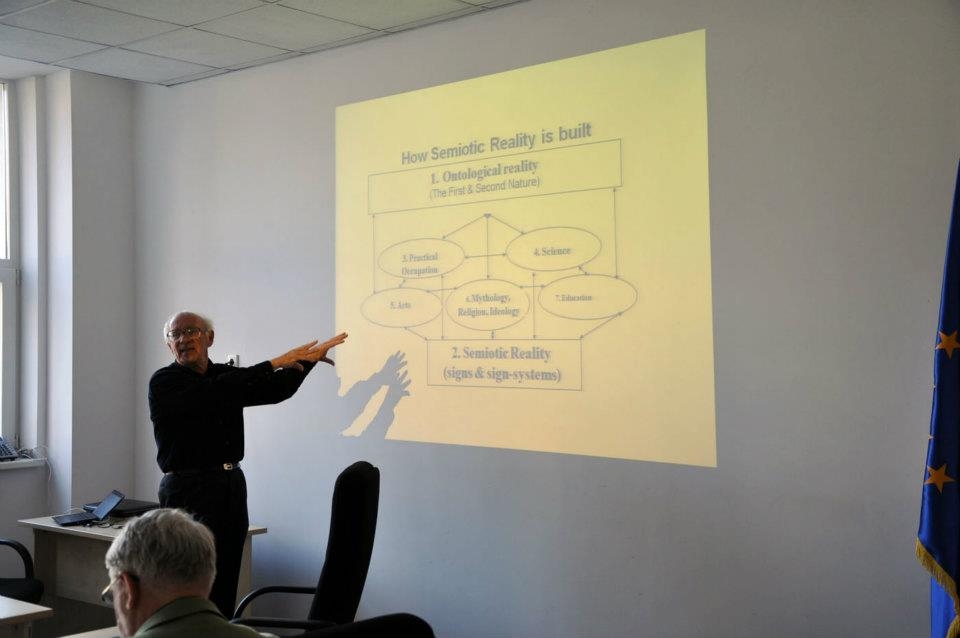
Semiotic reality, as I understand it, comprises all the signs and all the recognized sign systems in the world, designed by people in the process of human civilization. It is not less real than the objective ontological reality we usually deal with. It includes and sums up science, culture and arts. This reality to some degree is relevant to every person. With this vision of reality as a starting point, I am diligently developing a new philosophy of existence, which in my view includes four types of reality; namely, ontological, semiotic, virtual and mental realities.
In terms of your theory you presented a classification of signs. Please tell us more about its classes and the main criterion to categorize them.
The most popular innovation that I introduced into the theory of General Semiotics proved to be the classification of all currently existing signs. I have divided signs according to the degree of their abstraction into six categories, as you can see in the diagram below:

Each category constitutes a new stratum of signs fundamentally different from the previous strata and with a more developed capacity of depicting different sides of designated objects and ways of working with signs in relevant systems.
Every following level of the pyramid indicates a powerful headway to the human intelligence, an ability to acquire further sign-oriented capabilities. These categories really interlace in our personal destinies, comprising a unique personal identity. It has been frequently cited by some professionals in their studies from different areas of knowledge and practice. If you compare taxons to each other, you will understand what I mean by degree of abstraction (generalisation) of the signs, and by a more developed capacity of them to depict wider and deeper aspects of reality, as well as by new ways of treating signs (instead of working directly with subject matter), in order to acquire new knowledge. This taxonomy (primary classification) not only pursues the abovementioned classification by Charles Peirce, but it also expands upon it by explaining how new types of signs are systematically appearing and how their role in the history of mankind is understood and recognized.
Do you use your theory in practice? If so, please give us some notable examples, how this knowledge might help in our everyday life.
When the theory took shape in broad lines (it took final form in “A Theory of General Semiotics”, Cambridge Scholars Publishing, 2015), it crossed my mind to put it to the test in different uses. Here is one of them.
The Moscow Underground Scheme. Once I stood in front of the Moscow Underground Scheme trying to find the Polyanka station, but without success. I have never lived in Moscow and I did not have a slightest idea of where the station was located. Then I decided to suggest some semiotic improvements of the scheme. I advised to add the names of all the stations in alphabetical order to the legend of the scheme and to label each name by a colored symbol of the line it is situated on. This suggestion agreed with my experience of compiling dictionaries, where all the words are placed according to the alphabetical order of their first letters, and it agreed with my fascination with map-making. My research paper “On distribution of the Information on different parts of map-model” was published in a small booklet on map-making in 2010, and in the year 2015, while visiting Moscow, I have found it was put into life on the schemes of the underground inside the subway cars and in the stations.
Semiotics seems to be useful in teaching process. Have you ever tried to apply it there?
In applied linguistics, which I practiced professionally being a teacher of the English language, I suggested including some semiotic aspects of the language systems into analysis of any language, along with common linguistic description. For example, in the book “On Language and Languages” I divided all descriptions of languages into a) purely philological approach, b) sociological analysis, c) semiotic analysis. The same I did in other research works on linguistics.
What do you consider your main achievement ?
Obviously, the most considerable innovations belong to the new science that I am trying to construct under the name of General Semiotics. There, in fact, was no such name before. I advanced the thesis that there are two types of semiotics, general and branch (specific) semiotics and tried to describe General Semiotics in its most fundamental manifestations. How did it turn out to be, if it succeeded at all, is still remains to be seen.
How the theory affected other fields of knowledge?
The most interesting outcome of my theory lies in the field of philosophy. Construction of the Theory of General Semiotics made apparent that many epistemological issues, which belong to the field of philosophy, should be alternated. They are, for example, the question of separating classifications from taxonomies, the question of separating notions from concepts and combining the latters into some conceptual grid specified for each science as well as for any of its branches. There are a lot of many other philosophical issues demanding some extensions and improvements.
What about various types of reality? Philosophers mainly consider there are two of them: Matter and Idea (Ontology and Mind).
When I declared the existence of the semiotic reality, I had to deal with existential philosophical questions about different types of reality and their mutual relations. The issue concerns and occupies me right now. My philosophy affiliation was reflected in the collection of articles “Who makes philosophy in Russia”, Part III, edited by Alexey Nilogov, Moscow, 2015. We have worked closely on some new research since then. Yet I would prefer telling more about my philosophic research in another interview.
Abraham Solomonick. Interviewed by Ekaterina Vylomova. October, 2016
© НОК CLAIM. Замечания, вопросы и сведения об ошибках просим сообщать в форуме или присылать администратору сайта.